Integration context for AI
AI is not the bottleneck.
It's your context.
The Problem
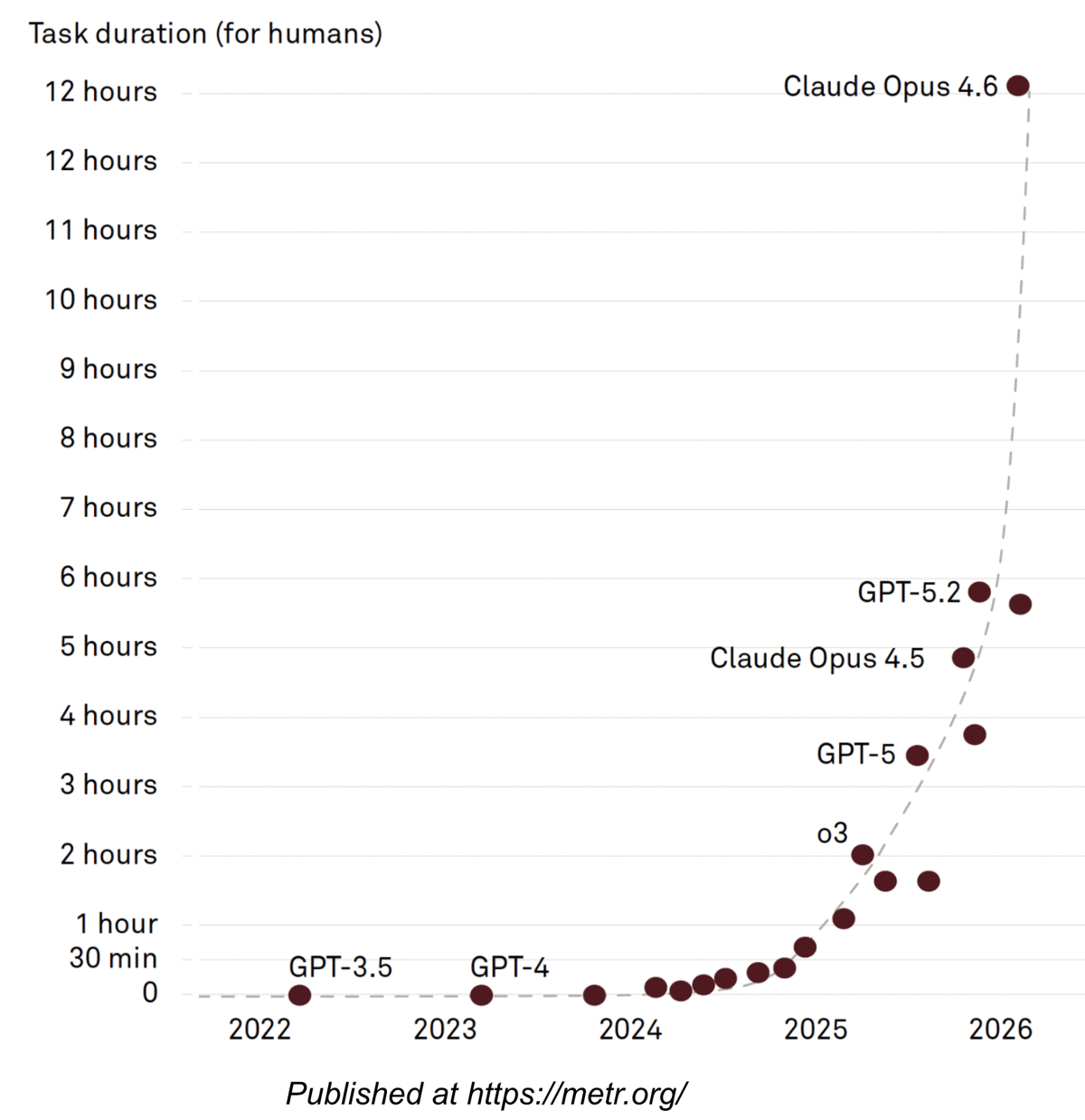
AI is getting exponentially more powerful. Is your organization?
AI capability is accelerating faster than anyone predicted. Models that handled 30-minute tasks in 2022 now tackle challenges that would take humans 12+ hours.
But here's the problem: most organisations can't use this power.
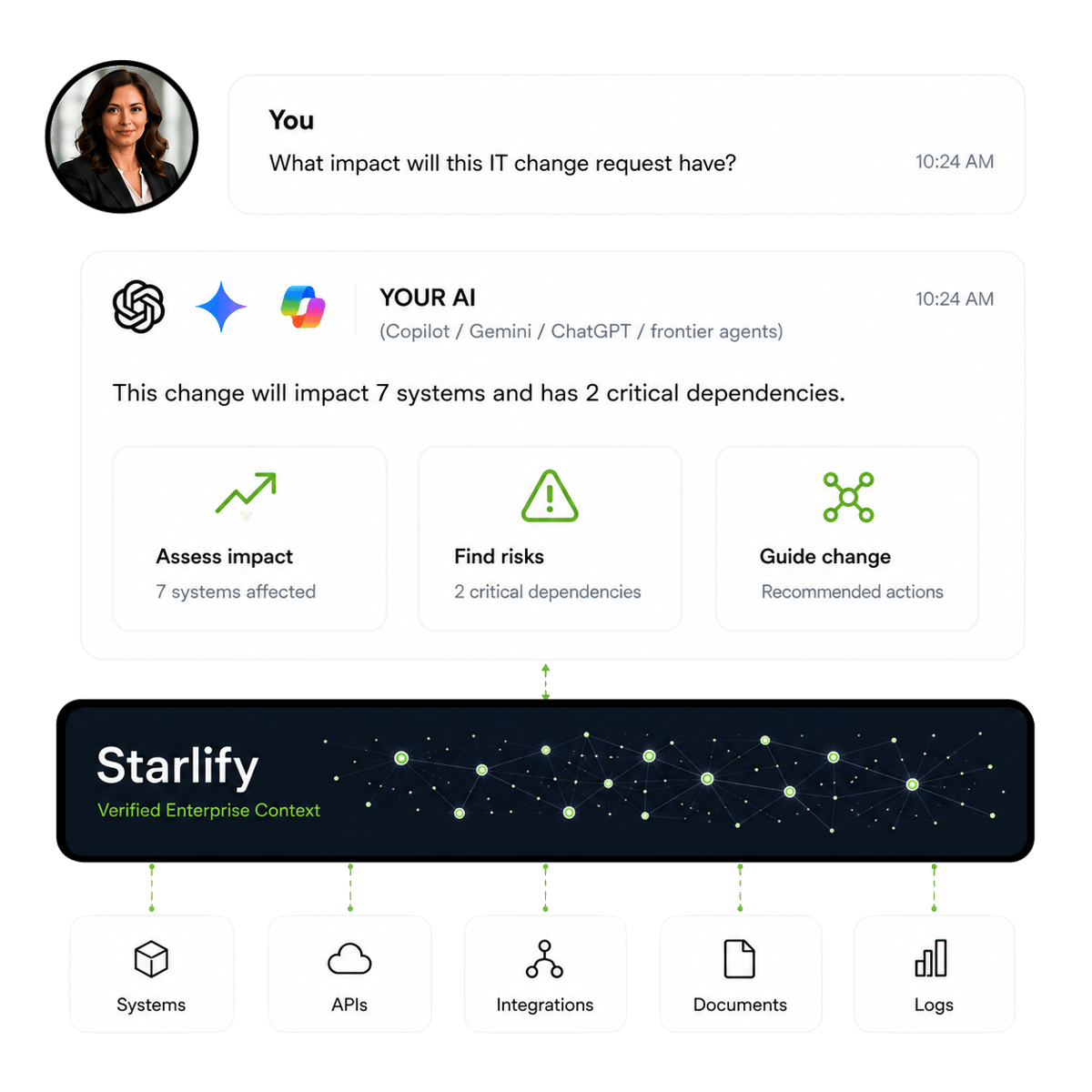
Not because the AI isn't ready. Because the AI doesn't know how your business works. It doesn't know which systems talk to each other, what data flows where, who owns what, or how a change in one place ripples through the rest.
Without that context, AI produces isolated point solutions. With it, AI can improve entire business systems.
The bottleneck in 2026 isn't AI capability. It's context.
STEP 1 - Understand
Map everything. Know where you are before you move.
Before AI can help you transform, it needs to know what exists. Starlify maps your integration landscape as structured, machine-readable metadata — systems, connections, data flows, ownership, and business context.
This isn't documentation that goes stale. It's a live model that grows and live with every team that uses it. The more complete your map, the more powerful every tool that reads it becomes.
Most organisations spend weeks in workshops just to understand what they have. With Starlify, you have a queryable (for AI) and visual (for us humans with eyes) model in hours.
STEP 2 - Transform
AI becomes the architect with instant access to current state.
Your team stays in control.
With your landscape mapped, AI can start reasoning about your business. In two ways:
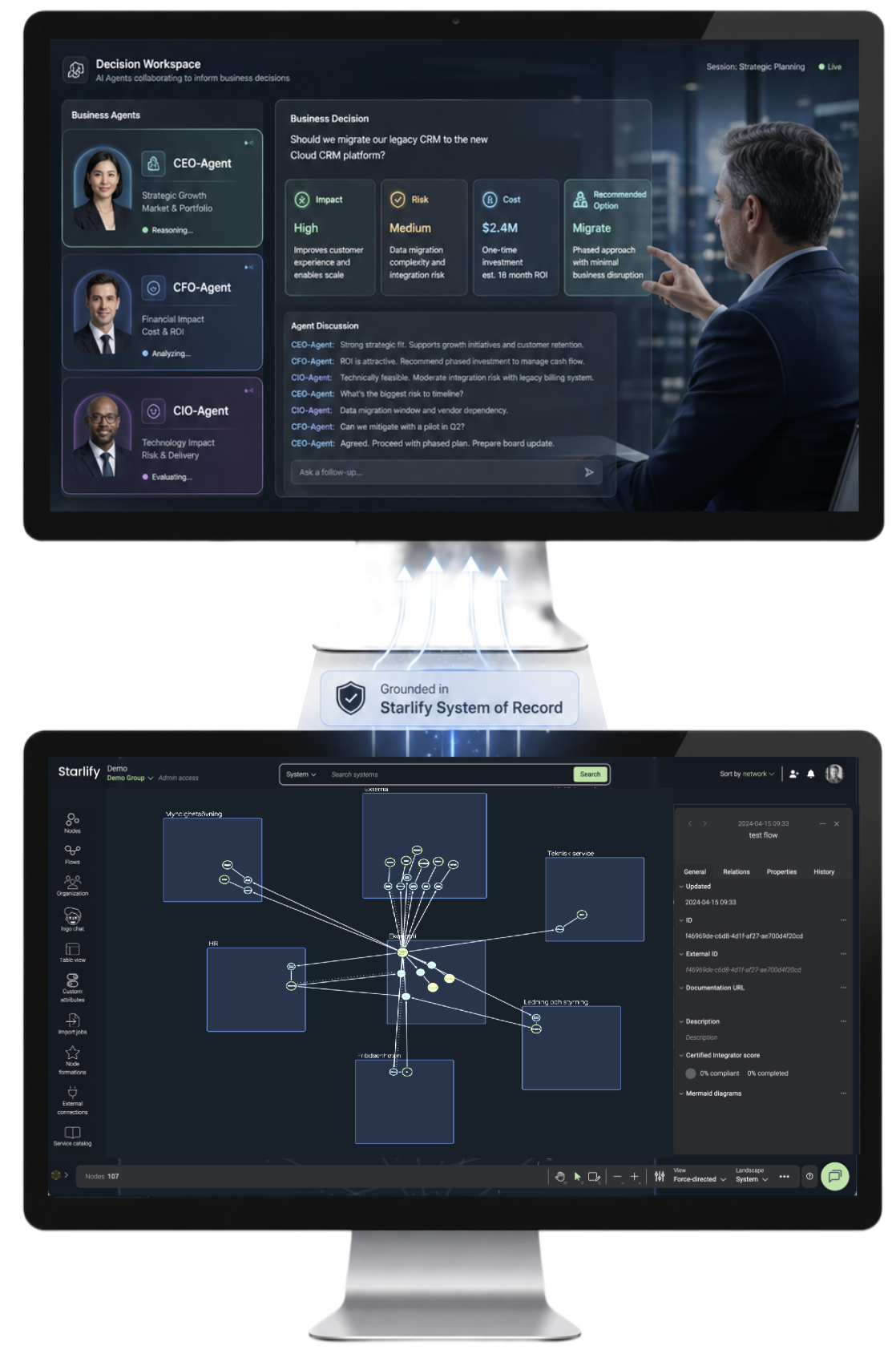
Ingo AI — Starlify's built-in meta-data agent. Talk to your integration context in natural language. Ask about dependencies, impact, ownership, data flows — any IT question grounded in how your systems actually work togehter. Ingo lives inside Starlify and gives every team member instant access to the full picture.
Bring your own AI. Starlify exposes your integration context through API and MCP, so any AI agent can access it directly. A project lead asks "which systems are affected by this migration?" A strategist asks "how ready are we to consolidate our Nordic platforms?" A program manager asks "what are the dependencies across our three parallel initiatives?" A C-level might ask "how executable is this strategy"? Every question answered in seconds, grounded in real context - not tribal knowledge or meetings next month or quarter.
Whether it's Ingo or your own agents, AI finally has the context to help you move in the right direction. Not just faster — but toward the right target.
STEP 3 - FLOW & CONTROL
Three forces. One compounding advantage. The gap is increasing.
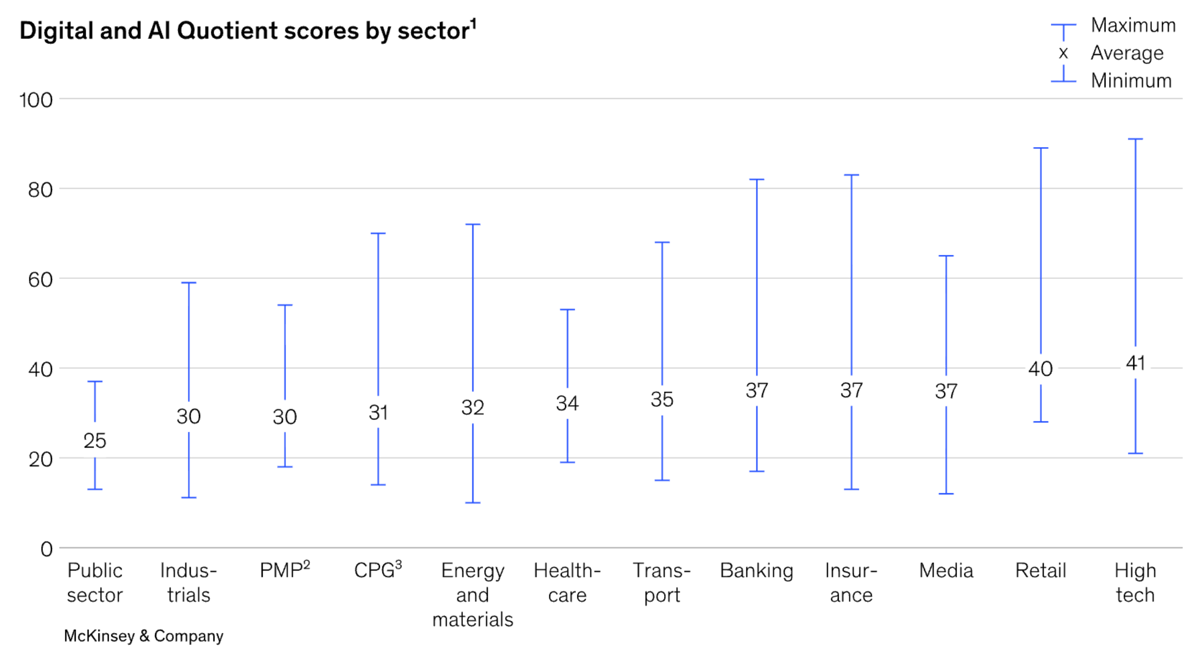
Winners in the digital and AI race harness three forces:
Metadata — the map of your business. Topology, dependencies, ownership. This is what Starlify structures.
Data — the signal. The information moving through your integrations. Gives agents an operational grasp — the ability to read, write, and act across systems.
Agents — the analytical power. Strategic, tactical and operational reasoning.
Each force amplifies the other two. The cycle accelerates. That's the compounding advantage.
As in the Entiros logo these forces create a flywheel. The fastest way to become agentic in the entire organization.
Proven success
You're in good company

Haglöfs started its journey to modernize the IT landscape in 2020 to catch up with the accelerated demand for integrations. They needed a solution where the IT department could greatly simplify and monitor the distributed connections from third-party IT solutions and, by doing so, save valuable time and money on their projects and forward initiatives.
Keolis needed to know the current state of its integration landscape. With Starlify as a visualization tool, it brought insight into which integrations exist, that are needed and how the information flows throughout their landscape.
GANT needed transparency and structure to their IT solutions for 45 different markets. Starlify contributed with increased data availability and flexibility, lowering the development cost and faster time to market for new systems and services.
Volvo's demand for integration has boomed in recent years. Starlify visualizes the current state of its integration ecosystem and helps to understand how the information flows between teams, functions, departments, and partners. This enables Volvo to accelerate its digital transformation.
FAQ about Starlify
What is the secret sauce in Starlify?
...good that you are asking :). We think it is 3 things that make Starlify shine
- Our Certified integratorTM standard including a strong meta-data model
This allows teams to view their integrated networks through the same lens = foundational!
This model is open for anyone to use and reproduce works on.
As of today, +10.000 applications are described using the "CI-standard" with a +10 year heritage in use. - Our Ingo AITM integration intelligence
Starlify doesn’t just collect and visualize integration meta-data — Ingo AI decides what is correct.
Across teams and AI agents, Ingo ensures:
- Syntax – Data is structured and consistent
- Semantics – Meaning is aligned across the organization
- Scope – Nothing is missing, from flows to field-level mappings
- Our StarlifyTM user interface that allows for human understanding and the "human touch" of control
We did not vibe code it :) We built a beautiful, scalable, secure and very visual application that let users graphically navigate their application network- wohoo!
A Starlify snapshot is like looking at a night sky of stars, where you can quickly filter out and highlight your end-to-end star formations.
A Starlify live view is like looking at a flock of Starlings - yes - this is why we named it Starlify back in 2019 :)
We saw back then that as each applications development stops being the bottleneck - the observability and control of the "system of systems" is the next level of development focus.
...so we are "still confused" but on a higher level ;)
How do I get data into Starlify?
You can:
- Bring your own AI (e.g. copilot) to send proposals to our agent Ingo that incorporate your network into the larger network
= preferred! - Do it node by node by hand - either by yourself or as a team :)
- Import nodes via our JSON import
- Bulk import or Copy/Paste from a spreadsheet
- Use our SDK to connect to almost anything out there
- Use our Starlify API and build something fancy :)
Can I restrict access for certain users?
- Admin
- Write
- Read
We're more than 10 people in my team. Can I add more users?
Levels of users?
Can I customize the graph?
How do I find things in Starlify?
Can I show how the data flows in my landscape?
Can I see which application uses sensitive data such as GDPR?
Can I define an end-to-end flow and show it in the graph?
Can I save my organized nodes?
Can I see who's in charge of a system or flow?
This is Starlify
Build better integrations by collaboration and insight
Starlify visualizes the dependencies within your integration ecosystem and acts as a tool to drive change across your organization. With better insights, you can increase the pace of digitalization and focus on what really matters.
Take your organization from a centralized to a distributed integration landscape where collaboration is the key to business success. Starlify empowers you to lead the future of integrations and helps your digital ecosystem thrive.